REVIEW · TEMPLE & SPIRITUAL TOURS
Mumbai Temple Tour in Private Vehicle
Book on Viator →Operated by Shreeji Tours n Travels · Bookable on Viator
Mumbai’s faiths show up fast.
This private, full-day spiritual route pulls together Hindu, Jain, Christian, Muslim, and Buddhist landmarks into one moving day—so you can see how religion shapes daily life right on the city’s streets. I love that it’s set up as a private tour (you’re not stuck with strangers), and I also like the front-door pickup and drop-off so you lose less time to taxis and waiting.
What I like most, though, is how the day is paced by an English-speaking guide who explains what you’re looking at before you step in. You get bottled water, an air-conditioned vehicle, and the freedom to ask questions as you go—exactly the kind of context that turns sightseeing into understanding. If you’re lucky, you may catch temple and church activity such as an aarti, and on certain dates ceremonies can be happening in real time.
The one potential drawback: it’s a long 6 to 8 hours in one shot, and most stops are “see it, feel it, move on” rather than long museum-style lingering. Also, there’s no meals included, so plan for breaks that fit your energy and hunger level.
In This Review
- Key Things That Make This Tour Worth Your Time
- A Private Multi-Faith Day in Mumbai (Not Just Temple Photos)
- Getting Rolling: 9:00 AM Start and Comfort in an A/C Car
- Stop 1: Shree Siddhivinayak Ganapati Mandir in Prabhadevi
- Stop 2: Mahalakshmi Temple and the City’s Devotion to Wealth
- Stop 3: Babulnath Shiva Temple Near Girgaum Chowpatty
- Stop 4: ISKCON Chowpatty at the Radha Gopinath Temple
- Stop 5: St. Thomas Cathedral Mumbai (A 300-Year-Old Church Stop)
- Stop 6: Babu Amichand Panalal Adishwarji Jain Temple
- Stop 7: Banganga, the Sacred Water Tank From the 12th Century
- Stop 8: Nipponzan Myohoji Buddhist Temple and Its Japanese-Buddhist Roots
- Stop 9: Mumba Devi Temple, a Local Incarnation of the Mother Goddess
- How the Day’s Timing Really Feels: 6 to 8 Hours, But Not All Equal
- Ceremonies You Might See: From Aarti to Festival Energy
- Price and Value: What $98 Covers (and Why It Can Be a Good Deal)
- What You’ll Learn From the Guide (Names You Might Encounter)
- Who This Tour Suits Best (And Who Might Not)
- A Simple Reality Check: It’s Spiritual, Not Sport
- Should You Book This Mumbai Multi-Faith Temple Tour?
- FAQ
- What is the price for this tour?
- How long is the tour?
- Is pickup and drop-off included?
- Are tickets and admission fees included?
- What’s included in the tour?
- Are meals included?
- What time does the tour start?
- Is this tour private?
- What if the weather is bad?
- Can I cancel for a refund?
Key Things That Make This Tour Worth Your Time
- Door-to-door pickup from your hotel, airport, or train station keeps the day smooth
- A/C private vehicle plus bottled water helps you survive Mumbai heat and traffic
- English-speaking guide guidance at each major stop so you know what you’re seeing
- Free admission at every listed site means the itinerary stays budget-friendly
- Multi-faith stops across Hindu, Jain, Christian, Buddhist, and more in one route
- Ceremonies possible (like aarti) depending on timing and local worship schedules
A Private Multi-Faith Day in Mumbai (Not Just Temple Photos)
This is the kind of tour I recommend when you want more than a checklist. You’re not only visiting religious buildings—you’re getting the cultural frame that helps you understand why people behave the way they do when they pray, sing, or observe rituals.
The fact that it’s private matters. With a small group (up to 2 in one booking), you can move at a comfortable pace, ask questions without feeling rushed, and spend those short stop windows more intentionally. It also means you can ask your guide for small practical tips about what to notice in each place.
You’ll also feel the operator’s “keep it easy” approach. Bottled water is included, you travel in an air-conditioned car, and tolls and parking fees are covered. That last part sounds minor, but it helps prevent the day from turning into surprise add-ons mid-route.
You can also read our reviews of more private tours in Mumbai
Getting Rolling: 9:00 AM Start and Comfort in an A/C Car
The tour starts at 9:00 am, so you’re already ahead of the day’s hotter stretch and peak traffic. You’ll get pickup from where you’re staying (or from the airport or train station if that’s where you land).
You’ll travel in a private A/C vehicle with an English-speaking local guide. Mobile ticket delivery is included, which makes the handoff on the day easier than chasing paperwork. And you’re not paying separate tolls or parking fees along the way.
In short: you’re buying time and comfort. In Mumbai, that’s not a luxury—it’s how you actually enjoy the sites.
Stop 1: Shree Siddhivinayak Ganapati Mandir in Prabhadevi
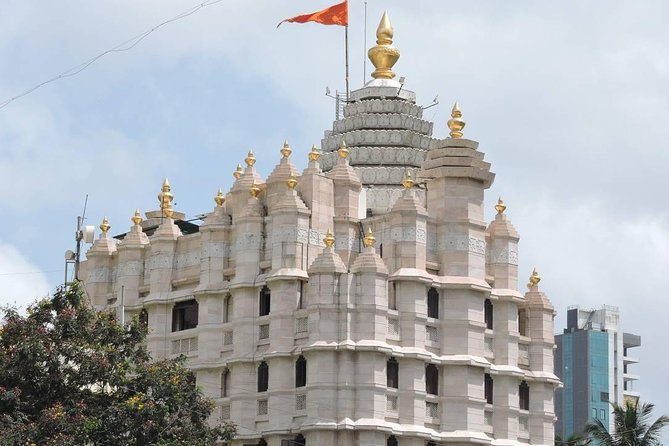
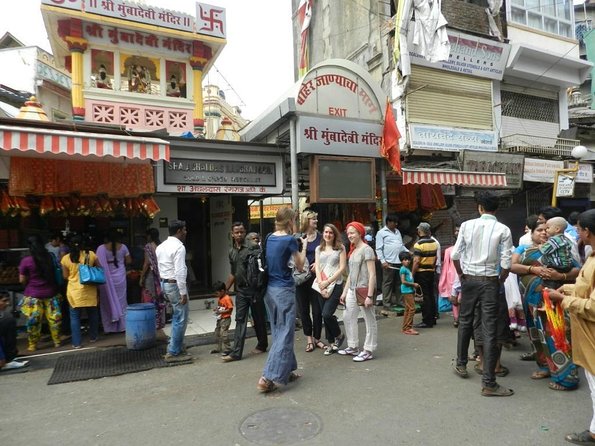
Your day begins at the Shree Siddhivinayak Ganapati Mandir, dedicated to Lord Shri Ganesh. This temple sits in Prabhadevi, and you get about an hour here with admission listed as free.
Ganesh is a strong first stop for a reason: he’s widely associated with beginnings and good starts, so the vibe on arrival is often focused and intentional. Watch how people approach—where they pause, how they move, and what they seem to ask for. With your guide’s context, you’ll understand the symbolism rather than just observing a crowd.
Practically, plan to arrive ready to pay attention. A big Mumbai temple can look chaotic from the outside, but once you know what’s happening, it becomes easier to follow the flow.
Stop 2: Mahalakshmi Temple and the City’s Devotion to Wealth
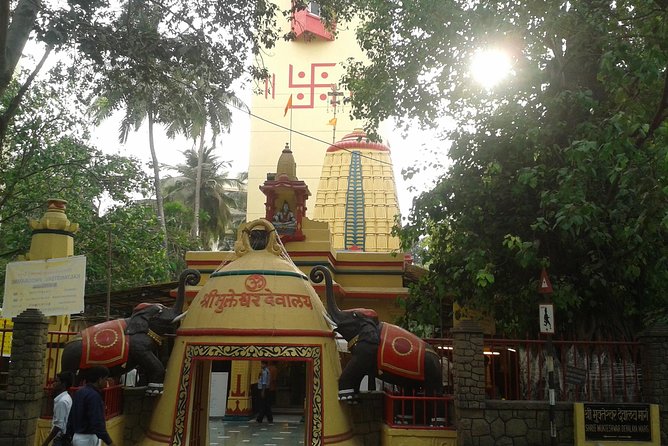
Next is the Mahalakshmi Temple, one of the older temples in the city. It’s dedicated to Goddess Mahalaxmi, often described here as the goddess of wealth, and you’ll spend around an hour with free admission.
This stop is a great reminder that religious meaning isn’t only about the building. It’s about what the community seeks—prosperity, protection, balance—expressed through daily worship. If you like to understand people as much as places, this is a strong moment.
Mahalaxmi is also a helpful contrast after the Ganesh opening. You can feel how different devotion styles can look very similar at first glance but carry distinct spiritual goals.
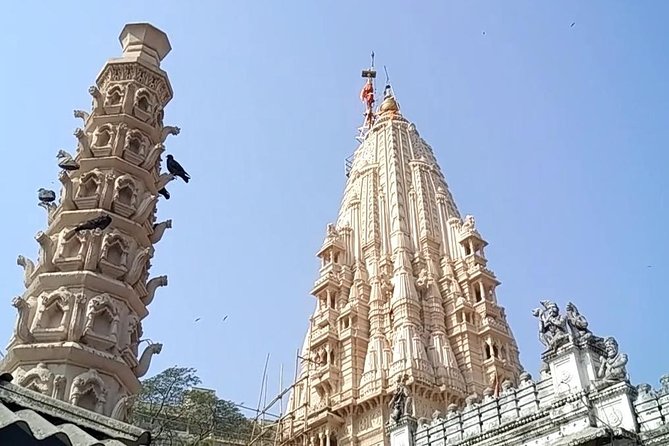
Stop 3: Babulnath Shiva Temple Near Girgaum Chowpatty
From there, you head to Babulnath Temple, an ancient Shiva temple located on a small hillock near Girgaum Chowpatty. You’re there for about an hour, and admission is free.
This is a stop that often gives you more than one kind of payoff. The “hillock” setting means you’ll probably notice the rise and change in viewpoint as you approach. And because the main deity is described as Shiva in the form of the Lord of the Babul tree, the guide can point out details that make the temple feel specific, not generic.
Shiva temples tend to reward people who slow down a bit. Even if you only have an hour, you can still take in the atmosphere if you’re not rushing to the next photo.

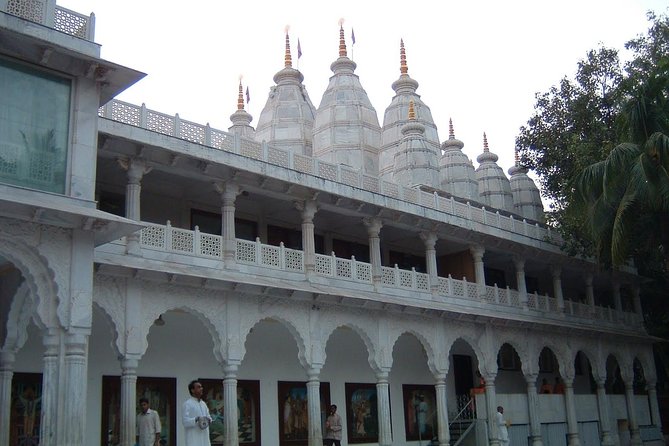
Stop 4: ISKCON Chowpatty at the Radha Gopinath Temple
Your fourth stop is the Sri Sri Radha Gopinath Temple at ISKCON Chowpatty, listed as about 30 minutes with free admission. This is dedicated to Lord Krishna, and it’s a perfect pivot point in the day because it brings a different devotional style into the same urban religious map.
If you’re timing your trip well, this is one of the places where you might catch ceremony moments such as aarti. That matters because it turns your visit from passive viewing into shared ritual time, even if you’re simply watching respectfully.
Even when nothing dramatic is happening, you’ll still get a quieter, focused feel compared with the more high-energy main temple crowds. It’s a useful pause before you head to the Christian site.
Stop 5: St. Thomas Cathedral Mumbai (A 300-Year-Old Church Stop)
Next is St. Thomas Cathedral Mumbai, described as a 300-year-old cathedral church connected with the Diocese of Mumbai. You’ll spend about 15 minutes here, and admission is free.
This is where the tour does something smart: it doesn’t treat “religion” as only Hindu and Jain stops. The cathedral is named for Saint Thomas the Apostle, who is believed to have brought Christianity to the region, and the guided explanation helps you connect that story to what you see on-site.
Short stop length can be a good thing here. In a church, the architecture and spiritual atmosphere can hold your attention quickly, and you don’t need hours to understand the purpose if your guide points you toward what matters.
Stop 6: Babu Amichand Panalal Adishwarji Jain Temple
After the cathedral, you move to a Jain temple: Babu Amichand Panalal Adishwarji Jain Temple. It’s listed as around 10 minutes, free admission, and located at Malabar Hills (Walkeshwar Road).
Even in a short window, Jain sites often feel distinct in tone—cleaner lines, a different rhythm in how people worship, and a strong sense of devotion. Your guide’s role becomes extra important here because the name itself carries lots of context that you wouldn’t automatically catch on your own.
If you’re the type who wants to notice differences between faiths, don’t treat this as a quick detour. The point of the day is comparison, and this is one of the clearest contrasts.
Stop 7: Banganga, the Sacred Water Tank From the 12th Century
Your seventh stop is Banganga, a sacred water tank listed as about 20 minutes, with free admission. The origin is described as dating back to the 12th century, and it’s part of the Walkeshwar temple complex.
This is a great “pause” stop. Instead of only focusing on buildings, you get a look at sacred water and how historical place features become religious meaning-makers over time. If you enjoy street-level history—how old structures shape today’s rituals—Banganga is the kind of stop that sticks with you.
It’s also a reminder that religious life isn’t only inside walls. In Mumbai, sacred geography can be a tank, a courtyard edge, a lane, or a shrine you’d otherwise walk past.
Stop 8: Nipponzan Myohoji Buddhist Temple and Its Japanese-Buddhist Roots
Next is the Nipponzan Myohoji Budha Temple, about 15 minutes, free admission. It was established in 1956, and the tour information connects it to a more-than-700-year-old prophecy by the Japanese Buddhist monk Nichiren (dated here to the 13th century).
This stop expands the day’s “many faiths in one city” idea in a way that feels concrete. You’re not just hearing that Mumbai is diverse—you’re seeing it through a temple that traces connections across oceans and centuries.
If you’re sensitive to atmosphere, Buddhist spaces often offer a different kind of quiet than the more crowded Hindu temples. Even a brief stop can reset your senses before the final temple.
Stop 9: Mumba Devi Temple, a Local Incarnation of the Mother Goddess
The last temple stop is Mumba Devi Mandir, listed around 20 minutes with free admission. It’s dedicated to Goddess Mumba, described as the local incarnation of the Devi, and it’s tied here to the mother goddess Durga.
This is a strong closing point because it brings the day back to a distinctly local expression of larger religious themes. You can sense how Mumbai’s religious identity blends pan-Indian devotion with area-specific reverence.
By now, you’ve seen enough styles that the small differences stand out. The guide’s explanations help you keep the threads straight, so the final stop lands with meaning rather than fatigue.
How the Day’s Timing Really Feels: 6 to 8 Hours, But Not All Equal
Officially, the day runs 6 to 8 hours. The listed time per stop totals roughly under five hours, which means travel between locations and real-world walking time fill the rest.
Here’s the key: the stop lengths are short enough that you won’t get buried in any single place, but long enough for questions and basic orientation. This works especially well if you want to see multiple faiths in one day and don’t want to spend your vacation only in one neighborhood.
Because the schedule is tight, I suggest you go in with a calm mindset. Instead of trying to memorize everything, pick two stops where you want deeper attention. Let the others be your visual and emotional snapshots.
Ceremonies You Might See: From Aarti to Festival Energy
One of the reasons this tour earns strong ratings is that worship isn’t always static. On some days, there may be ceremonies underway, and you could see things like aarti at ISKCON Chowpatty. Depending on timing, you might also experience festival-level energy—one departure was timed with Diwali and the sense of shared city celebration added a lot to the day.
You can’t guarantee ceremonies on any single date, but this is exactly the type of tour where your guide can point out what’s happening and why people are gathering. That’s how the tour stops become stories instead of backdrops.
Price and Value: What $98 Covers (and Why It Can Be a Good Deal)
The price is $98.00 per group (up to 2). If you’re booking with a partner or traveling with a friend, that can come out to about $49 each, which is where the value starts to look very real.
For that money, you’re getting:
- a private air-conditioned vehicle
- pickup and drop-off
- an English-speaking local guide
- bottled water
- toll and parking fees
What you do not get is meals, and there’s no mention of VIP entry. Still, most of the core stops list free admission, which keeps your day from turning into a pay-per-stop experience.
So the math works best when you want a guide and private transport for a full day, not when you’re trying to do it on your own with transit and multiple tickets. If your goal is maximum understanding per hour, this private format helps.
What You’ll Learn From the Guide (Names You Might Encounter)
A big part of the appeal is the guide’s role in setting context right before you enter each site. Names mentioned with this tour include Siddhi, Sameer, Sanseer, and Vikrant. Whoever you get, the pattern stays similar: clear explanations of what you’re about to see, room to pause and absorb, and answers when questions come up.
That matters because many religious sites can look similar from far away. Your guide helps you read the differences—who people are praying to, what the space is for, and what actions mean.
If you like to ask why things are done a certain way, you’ll enjoy this format. If you prefer a quiet walk with minimal talking, you can still get value by listening to the quick orientation your guide provides before you move.
Who This Tour Suits Best (And Who Might Not)
This tour fits you best if:
- you want multiple faiths in one focused day
- you prefer private comfort over crowded group buses
- you like learning through explanation, not only through photos
- you’re short on time in Mumbai and want a smart route
It may not be ideal if you:
- hate long days and want slow museum-style pacing
- need meals provided (since none are included)
- want long, unstructured time in just one or two sites rather than a full circuit
A Simple Reality Check: It’s Spiritual, Not Sport
This is a spiritual-themed circuit, so expect a lot of respectful attention and a steady flow between places. If you bring a flexible attitude and keep moving when your guide tells you it’s time, the day feels smooth.
The biggest “win” isn’t only the temples. It’s the way the route helps you understand Mumbai as a religious city where different communities share space and shape the streets you walk.
Should You Book This Mumbai Multi-Faith Temple Tour?
Yes, I think you should book it if you want a guided, air-conditioned way to experience Mumbai’s religious variety in one day. The combination of private pickup/drop-off, English guidance, bottled water, and multiple free-admission stops is a practical setup that protects your time and your comfort.
If you’re the type who needs meals handled, or you prefer slower pacing, consider pairing this with nearby food on your own before or after. But if your goal is a meaningful day with context—Ganesh, Mahalakshmi, Shiva, Jain devotion, a church visit, Buddhist space, and Mumba Devi—this route gives you a lot to work with.
FAQ
What is the price for this tour?
It costs $98.00 per group for up to 2 people.
How long is the tour?
The duration is listed as approximately 6 to 8 hours.
Is pickup and drop-off included?
Yes. Front-door pickup and drop-off are included from your hotel, airport, or train station.
Are tickets and admission fees included?
Admission is listed as free for each of the listed stops.
What’s included in the tour?
Included features are an air-conditioned vehicle, private transportation, bottled water, pickup and drop-off, a local English-speaking guide, and toll tax and parking fees.
Are meals included?
No. Meals are not included.
What time does the tour start?
The start time is 9:00 am.
Is this tour private?
Yes. It’s described as a private tour/activity, so only your group participates.
What if the weather is bad?
The experience requires good weather. If it’s canceled due to poor weather, you’ll be offered a different date or a full refund.
Can I cancel for a refund?
Free cancellation is available. You can cancel up to 24 hours in advance for a full refund. If you cancel less than 24 hours before the start time, the amount paid will not be refunded.